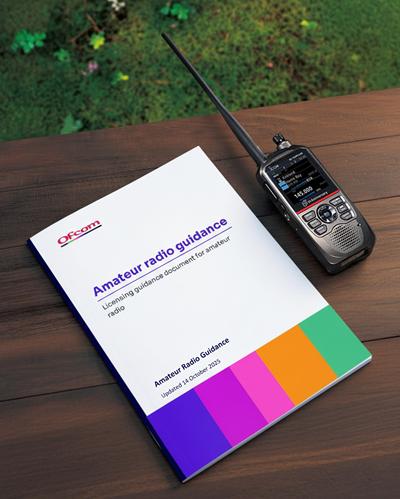
Changes To Amateur Radio Licensing In Relation To D-STAR
This year the RSGB and Ofcom have concluded an overhaul of the amateur radio licensing framework, which began in February 2024.
For users of D-STAR, the changes represent more than just an administrative clean up. It fundamentally changes how you identify your digital station, how you set up your hotspot or gateway and the power you can use to reach that distant repeater.
Here is a brief summary of the changes in relation to D-STAR use:
Simplified Digital Identification
One of the most significant changes for D-STAR users involves how you program your radio's MYCALL field and use suffixes.
Suffixes & RSLs: The mandatory use of Regional Secondary Locators (like the 'M' in MM7 or 'W' in MW7) is now optional for most. If you are a D-STAR user in Scotland, you can now simplify your programmed callsign to your primary format (e.g. G7XXX instead of GM7XXX) unless you hold a '2' series (Intermediate) licence.
Automated ID: Ofcom has clarified that for digital modes where the callsign is embedded in the data stream (like the D-STAR header) this satisfies the requirement for clearly identifiable transmissions, provided it happens at the start and end of a session.
D-STAR Gateways & Hotspots
Previously, setting up a permanent D-STAR gateway or Personal Access Node often required a specific NoV.
NoV Integration: Many types of low-power gateways are now integrated directly into the standard licence terms. This makes it significantly easier to set up home-brew D-STAR hotspots (like those based on Raspberry Pi/MMDVM) or local gateways without the paperwork trail previously required.
Interference Assessments: While the NoV requirement is relaxed, the responsibility remains on the operator to perform an interference assessment to ensure their station does not cause interference to others.
Power Increases for Digital Reach
D-STAR is often praised for its narrowband efficiency, but a bit of extra power never hurts when trying to access a fringe repeater.
Foundation Users: Can now operate at 25W (up from 10W) providing a much-needed boost for mobile operation.
Intermediate Users: Power levels have doubled to 100W.
Full Licence Holders: Can now transmit up to 1000W in primary bands, though D-STAR remains primarily a VHF/UHF mode where such power is rarely needed.
Remote Operation & Internet Linking
Since D-STAR is inherently linked to the internet, the new rules regarding remote control are a major win.
Internet Remote Control: Foundation and Intermediate licensees are now officially permitted to use internet-based technologies to control their stations remotely. This means you can more freely use Icom’s RS-BA1 software or terminal mode/access point mode via the internet to stay connected to the D-STAR network while away from your primary shack.
To view the updates in full, visit the Ofcom website:
Ofcom Spectrum Licensing System Updates.
Alternatively, you can call the Ofcom Spectrum Licensing advice line on
020 7981 3131.
Icom UK Sales -
sales@icomuk.co.uk
05/02/2026