What Are The Differences Between Various Marine VHF Antennas?
Reliable radio communication is the backbone of safe and efficient maritime operations. At the heart of this communication are VHF (Very High Frequency) antennas, which are essential for reliable communication between vessels and shore stations. With a variety of options on the market, choosing the right VHF antenna can seem complex. In this guide, we'll break down the key differences between marine VHF antennas and explain how their design and gain affect your communication range, ensuring you can make the best choice to enhance your Icom radio's performance.
VHF Antenna Gain: Boosting Your Icom's Signal
Antenna gain refers to an antenna's ability to focus radio waves in a specific direction, essentially shaping the signal. You'll typically see gain measured in either dBd (decibels relative to a dipole antenna) or dBi (decibels relative to a theoretical isotropic radiator). Most reputable antenna manufacturers will quote both, and for context, Gain (dBi) = Gain (dBd) + 2.15.
Simply put, a 0dBd gain omnidirectional antenna radiates power equally in all directions (horizontally), much like a simple dipole antenna. For every +3dBd increase in gain, the antenna effectively doubles the radiated signal strength. It achieves this by compressing the signal into a flatter, more intense pattern. This increased intensity isn't just for transmitting; it also works in reverse, meaning your Icom radio will receive incoming signals with greater strength.
It might seem logical to choose the highest gain antenna available, but it's important to remember that antennas are passive devices – they don't have active powered components. This gain comes with a trade-off, which we'll explore shortly, to help you find the perfect balance for your Icom radio.
VHF Antenna Types: Finding the Right Match for Your Icom
There are three main types of VHF antennas used in marine environments, each offering distinct characteristics that can pair effectively with your Icom
marine radio:
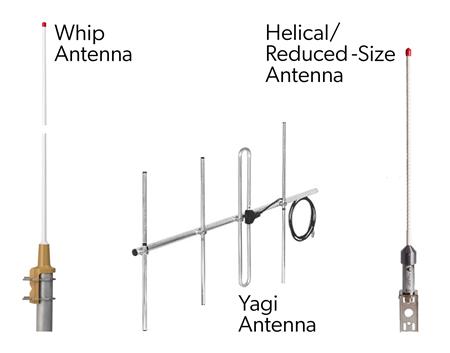
Whip Antennas: These are by far the most common VHF antennas for marine use. They radiate signals omnidirectionally (in a 360-degree pattern), which is ideal for a moving vessel needing to communicate in all directions. Whip antennas can be mounted at the masthead for maximum height or lower down on the deck, a stub pole, or a bulkhead. Depending on their gain, marine whip antennas are generally about 1m long (0dBd), 3m long (3dBd), or 6m long (5/6dBd). For most recreational vessels, a 1m or 3m whip antenna is a fantastic choice, providing robust performance that perfectly complements the clear audio and strong transmit power of your Icom VHF. The 6m length is typically reserved for much larger vessels where deck space and mounting options allow.
Yagi Antennas: Unlike whip antennas, Yagi antennas are highly directional. They need to be pointed directly at the target for effective communication. Because the signal is focused into a narrow beam, Yagi antennas offer significantly higher gain. They are primarily used for fixed shore installations or for point-to-point communication where a dedicated, strong link is required. While not typically found on recreational boats, a Yagi antenna could be beneficial for a fixed base station such as the
IC-F5022M for very specific, long-range shore-to-shore communications.
Helical/Reduced Size Antennas: These antennas are designed for compactness. You'll recognize the rubber-encapsulated helical antennas attached to nearly every Icom handheld marine radio, like the popular
IC-M25 EVO or
IC-M94DE. These compact designs prioritise portability. Additionally, reduced-size fixed antennas are available for fixed Icom VHF radios where a full-length antenna isn't practical due to space constraints. It's important to note that these antennas are less efficient, often exhibiting a gain of -3dBd or worse. This negative gain means the signal is effectively halved in both transmission and reception. For instance, the compact size of an Icom
IC-M330GE paired with a reduced-size antenna offers a convenient solution for smaller boats or where aesthetics is paramount, understanding that there's a compromise between size and ultimate performance compared to a full-sized whip.
Gain, Range, and the Perfect Balance for Your Icom Setup
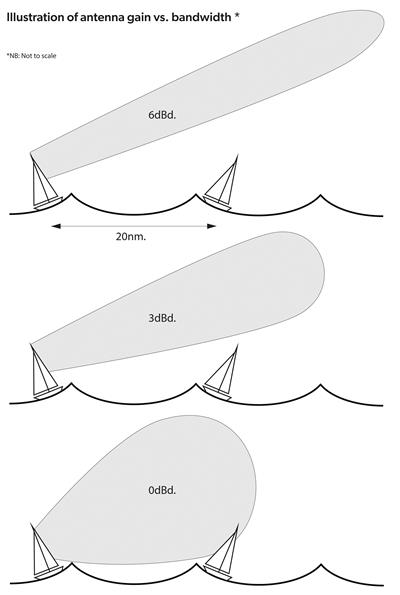
When considering omnidirectional VHF whip antennas—the most common choice for vessels—we need to revisit how higher gain is achieved. To focus the signal more intensely, the antenna "squashes" the radiated pattern into a flatter lobe, aimed more towards the horizon. The higher the gain, the flatter and narrower this lobe becomes.
This flattening can sometimes come at a cost: local communications can be sacrificed. Imagine your vessel on a choppy sea. As the boat pitches and rolls, a very flat, high-gain signal might "overshoot" or "undershoot" nearby targets. (Please see attached diagram). While a high-gain antenna offers a more penetrating signal beam, its compressed shape can actually reduce consistent contact with your intended target, especially in dynamic conditions.
For this reason, when pairing an antenna with your Icom marine radio, we generally advise against using anything over 3dBd for most vessels. In many situations, a 0dBd antenna offers the best balance, providing reliable, consistent communication across a wide range of conditions, ensuring your Icom radio performs optimally whether you're contacting a nearby boat or a distant coastguard station.
Conclusion
Choosing the right VHF antenna for marine applications can be a daunting task given the various options available to the market. The gain of an antenna is an essential factor that determines its performance and range. Omnidirectional whip antennas and helical/reduced size antennas are the primary types of VHF antennas used in marine applications. The gain of an antenna can be measured in dBd or dBi and it affects the antenna's range and coverage area. Higher gain antennas provide extended range and coverage than lower gain antennas but sometimes with a sacrifice over local coverage.
Icom UK recommends
Amphenol Procom marine antennas due to their world-renowned quality, reliability & performance.