What is DXing and DXCC?
The term DX started as the telegraphic shorthand for distance or distant contact. DXing refers to the practice of making contact with distant stations over the Amateur radio bands, probably the most popular and challenging aspects of the Amateur radio hobby.
DXCC refers to the
DX Century Club, an award scheme that started as a challenge to contact 100 countries or entities as they are now called and is administered by the Amateur Radio Relay League (ARRL) in the USA. To gain the award it requires a minimum of 100 entities confirming with either a QSL card or using the ARRL Logbook Of The World (LOTW) online system. They are called entities because it includes Islands that may be part of another country but separated by hundreds of miles, the North and South Cook Islands are a prime example. The ARRL DXCC desk sets the rules as to how this is worked out.
What determines DX?
DX or the term distant is subjective and depends on the band and equipment you are using. On HF DX can be thought of as a contact outside one's own country, especially to the other side of the world or an exotic island somewhere. On VHF/UHF this could be thought of as making contact with someone at the other end of the country. Depending on which VHF/UHF band you are using there is even the possibility of contacting another country, if you have the right antennas and the conditions allow even using a simple vertical can bring in distant contacts when the right atmospheric conditions are present.
DXing also sharpens your operating skills and expands your knowledge of the
Amateur radio bands and how propagation works at differing times of the day. For example if you are on top band in the middle of the day you would not be able to make contact with a station in the USA, but on 10 metres this would be entirely possible if it is at the right time in the sunspot cycle, whether with a beam antenna or simple wire. DXers will stay up all night to make that contact with a station on a far-off entity, most likely an uninhabited island that a team have put together an expedition to go and operate from there for a short period of time. These "DXpeditions" will take all their equipment, food, accommodation and power source with them just so a DXer can sit at home and get that contact with them on as many bands or modes they use. These entities may not have been on the air for a number of years due to their location and difficulty in accessing them.
DXpeditions generally cost quite a lot of money to put on and will more than likely have sponsorship from a manufacturer which might include radios, amplifiers, antennas etc to give them publicity in the Amateur radio world. They will also ask for donations from the Amateur community in the form of a small monetary donation or more if they can afford it. This can be done when or if you apply for a QSL card or simply a donation to the expeditions PayPal or bank account. The costs for these expeditions vary dependant on how rare and exotic the location is, which also determines how "most wanted" they are. For example, an expedition to a Caribbean island like Jamaica will not be as wanted as one to Bouvetoya Island in the South Atlantic which is higher on the ‘Most Wanted List.’
Most Wanted List
This is worked out by software on a website called ClubLog. Radio Amateurs upload their computer logs to the website and this then works out how many countries/Entities the individual has worked or confirmed. This does mean that you have to do some work to keep an accurate log book of contacts. Most operators use computers in the shack for this purpose that creates a file they can then upload to the website. This can be free software or from a paid subscription software. Every operator has their favourite and they all do much the same. You then upload to ClubLog once you have been registered for free. This is an amazing tool and certainly if used right will compute all your scores of what is confirmed and what is needed. From this information ClubLog then works out how many people have made contact with the individual entities and if there are a smaller number for one entity than another it then sorts into a list to show which are the most wanted.
Logbook of the World (LOTW)
Logbook Of The World or LOTW is run by the ARRL and is another online tool that allows you to get confirmation of a contact from other stations much like a QSL card that have uploaded their logs into the system. As long as the times, frequency and mode all match the confirmation is generated and is put into both logs. Then when you have the magic 100 countries/entities confirmed, a simple application process and form to fill in with a fee gets you the 1st certificate for your wall. Then subsequently as you get more confirmed you do an update to the next level and receive a sticker on your certificate until you reach the magic number of 330 of the 341 entities and you will be on the honour roll. This can be a lifetimes work and some people never get there no matter how hard they try.
If you don't get the LOTW confirmation you can also get a QSL card confirmation from the DX station to confirm the contact. These are then sent on to a card checker by numerous volunteers around the world who will look at the card and confirm on line that it is all okay. Once checked you can apply for the credits to be added to your LOTW account for use against your score. Again an accurate log book needs to be kept which is down to the individual to do the work for this and can be fun once the QSL cards and confirmations come in. Most of these bits of software allow you to upload live to ClubLog or LOTW as you make the contacts. They will also give you the option to download a file from LOTW that then is imported to your log and updates the scores automatically, but again will need you to make sure everything is accurate.
Making Contact With a DX Station
A DXpedition will create a lot of interest and callers on any of the frequencies and modes they call on. Mostly they will operate duplex meaning they will call on one frequency and listen for callers on another frequency. For example the DX station is calling on 14.200 MHz SSB and says "Listening up 5 to 10", this means he is listening for callers between 14.205 and 14.210 MHz. If you call on the frequency he is transmitting he will not hear you and you will have the wrath of the world on you for causing interference. So it is always better to listen to what the DX station is saying before calling. All of our radios allow this type of operation with just a simple press of a button and tuning the VFO. You may be lucky, especially if you get into the habit of tuning and listening to the bands and hear a DX station calling CQ where you are the only person on that frequency so answer them back and have a chat. If you don't mention their call in the overs until you are ending, you could have a nice conversation and become friends for life.
When you join in with the calling of the DX station this is called a pile up, like a pile up of cars as the DX station will hear a cacophony of noise and will pick out a callsign and give a report. Just don't call when he has not asked for your callsign or any letters in your call. This just makes it harder for the DX station to get his report and complete the contacts. It is always also worth listening to both the DX and the pile up to try and work out where he is listening, especially if he uses more than a 5KHz split mentioned earlier. Then put your calling frequency slightly higher or lower if you catch him tuning back down. You don't need kilowatts of power just tune your skills, especially your listening skills - 5 minutes listening can save you hours if you work out the DX stations habits of how he tunes.
All I can end on is have fun in the pile up and enjoy the "chase" of the DX, I have and still do.
Chris Colclough (G1VDP)
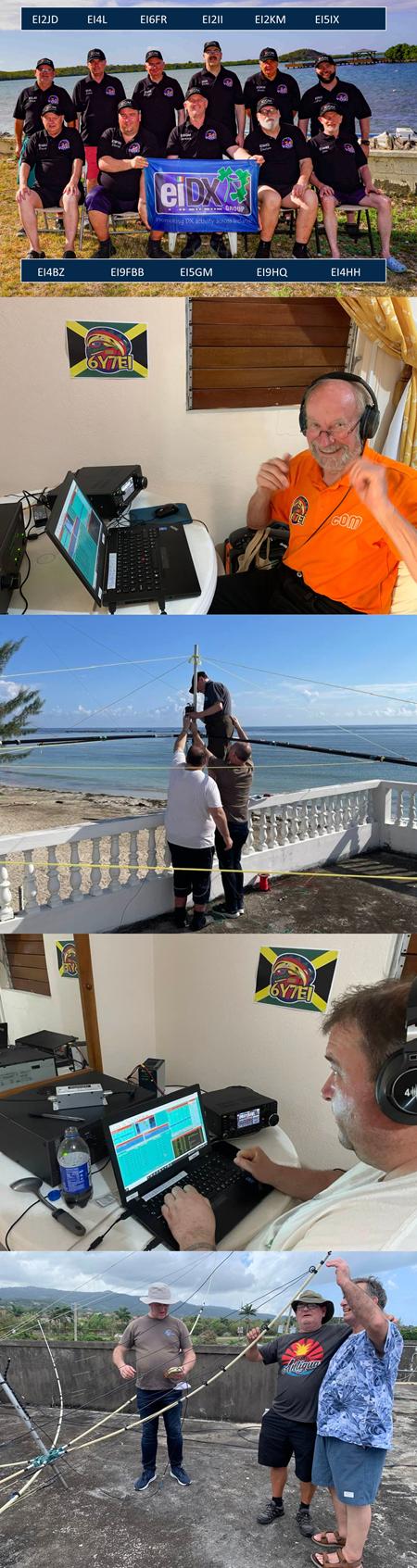
Pictures kindly supplied by David Deane EI9FBB
Radios used in the pictures are the Icom IC-7300 HF/50/70MHz Transceiver.