Two-Way Radio Buyers Guide
You've been tasked with buying two-way radios for your business, and the sheer number of manufacturers and solutions can feel overwhelming. How do you even start looking, stay on budget, and find what you truly need?
We've created this simple 10-point guide to help you navigate the process of matching your business communication needs to our range of Icom two-way radio solutions. Following these tips will make the process much faster, simpler, and less frustrating.
Let’s get started...
1. Why Choose Two-Way Radios for Your Organisation?
Hopefully, you've already answered this question and know you need to keep in touch with your staff. You're looking for an efficient, simple, and effective communication solution that you can control and easily manage. Two-way radios deliver on all these fronts.
Depending on your specific needs and applications, they can significantly increase safety, improve productivity, enhance customer or employee satisfaction, and ultimately boost your profitability.
2. What Can Two-Way Radios Do for You?
Two-way radio is an incredibly flexible form of communication. It can provide simple one-to-one communication within a small group or expand to multiple channels for different departments – perhaps one for everyone, one for management, one for security, and so on. You can use each channel like an intercom, allowing you to call individual people or groups instead of broadcasting to everyone.
Some radios feature scanning capability, allowing them to pick up conversations only from programmed channels. Depending on your needs, you can build complex radio systems that integrate not just communication but also security monitoring via GPS or CCTV, or provide coverage between groups over wide geographical areas using the internet.
3. Who Will Use Them?
The great thing about two-way radios is their ease of use. Anyone in your organisation can operate them with minimal training. You can deploy radios to specific staff groups, their managers, and more. The system is also easily expandable – as your needs grow, simply add more handsets. Two-way radios are ideal for security staff, farm workers, office staff, shop watch programs, shift workers, production line inspectors, playground monitors… the list is endless.
4. Understanding Two-Way Radio Technologies: From Analogue to Global Coverage
When considering where and how you'll use your radios, it’s important to understand the different technologies available, as they impact coverage and capabilities.
•
Analogue radios are still very popular and a robust solution. They can be as simple or sophisticated as digital systems. Analogue generally works better in rural areas and at the edge of radio range, offering no latency issues, and there are no plans from Ofcom to withdraw the service.
•
Digital radio solutions, like Icom's IDAS (Icom Digital Advanced System), offer significant benefits. They are incredibly spectrum efficient, doubling the number of potential users on a traditional 12.5 kHz channel. IDAS radios also feature outstanding audio quality with superb noise-cancelling properties. While analogue audio quality gradually deteriorates with static as distance increases, digital provides stable audio for longer, right up to the edge of the communication range. Many Icom digital radios are capable of analogue, digital, or mixed-mode operation, allowing for a phased migration from analogue to digital at your own pace.
Beyond traditional radio systems, advances in technology offer even more choices:
•
Icom’s IP Advanced Radio System, works over existing wireless LAN (WLAN) and IP networks. It's a licence-free system that provides secure communication via WLAN security protocols, ideal for excellent indoor coverage without complex cabling.
• The
Icom LTE Radio System is also licence-free and utilises the 4G/LTE mobile phone network to provide Push-to-Talk (PoC) two-way radio communications with mobile phone-like coverage. With a custom Icom SIM card, users benefit from a closed private network – simply turn on and use, no installation required.
• For ultimate flexibility, the
IP730D Hybrid Radio offers nationwide coverage over the LTE network combined with conventional VHF/UHF professional radio mode for local work.
• For truly global communication, Icom also has radio solutions that provide worldwide coverage with its
Satellite PTT system in conjunction with Iridium.
• Interconnecting Various Systems with the VE-PG4: To bridge diverse communication methods, Icom offers the
VE-PG4, a powerful RoIP (Radio over IP) Gateway. This device functions as a central hub, allowing seamless interconnection between various devices and networks. For example, it can connect your digital radios to analogue systems, or link radio networks to LTE/PoC devices, IP phones, and other communication platforms, creating a truly unified and flexible communication solution tailored to your needs.
These advanced systems offer benefits like no licence fees (for IP/LTE), encrypted communication, and excellent audio quality. They can be used like traditional radio systems with individual and group calling, all managed by allocating each handheld unit a 'personality' on the system. Installation can also be much simpler; for example, IP systems use wireless access points, while LTE systems leverage pre-existing cellular masts.
5. Two-Way Radio vs. Mobile Phones
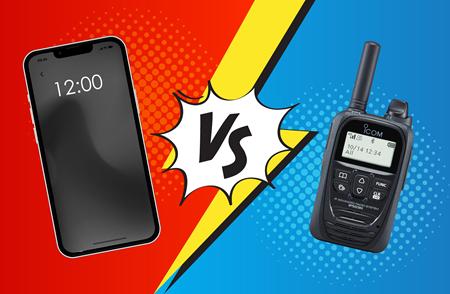
While mobile phones are widely used, two-way radios offer distinct advantages for business communication, particularly in critical situations:
Instant Communication With a two-way radio, you simply press a button and start talking. Mobile phones require dialing and waiting for a connection, which can be critical in an emergency.
Group Communication: Radios allow you to talk to multiple users simultaneously, which is essential for team coordination.
No Monthly Contracts Once purchased, there are no ongoing monthly fees, unlike mobile phones where you might worry about exceeding allotted time.
Robust & Durable Icom radios are often built to military specifications, meaning they are designed to withstand harsh environments, including wet conditions or accidental drops onto concrete – a standard most mobile phones can't match.
Reliability in Emergencies Two-way radios continue to work during natural disasters or major security incidents when mobile phone networks can become overloaded or fail.
On-Site Availability Radios typically stay on-site, making them readily available for use by different shifts or night workers.
Complete Coverage With repeaters, two-way radios can provide full coverage in all areas of your business, including spots where mobile phones might lose signal.
6. Types of Two-Way Radios for Business
Two-way radios are available in four main types:
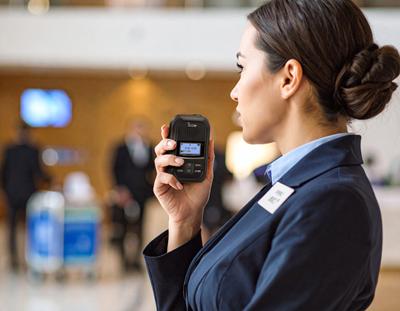
Handheld two-way radios These are the portable "walkie-talkie" style radios you see people carrying.
Vehicle-mounted mobile two-way radiosDesigned to be mounted in a car or truck, they use the vehicle's battery for power and often achieve better range with an externally mounted antenna.
Desktop base station radios:These use mains power and can be connected to an externally mounted antenna for improved range. Vehicle-mounted mobile radios are often adapted for this use by adding an AC to DC power converter.
Two-way radio repeatersThese devices extend the operational range of your PMR radio system, covering areas where direct radio transmission might not reach. A repeater receives a radio's transmission and rebroadcasts it further. Every Icom two-way radio for business, from the
IC-F1000 series to the advanced
IC-F3400D digital two-way radio series is repeater capable.
7. How to Choose Your Two-Way Radio System
With the array of functions and features available, choosing the right system can seem daunting. A good starting point is to clearly define what you want to achieve with your two-way radio system. Consider:
• How many people will use the radios?
• What is the typical operating environment?
The best approach is to involve an Icom business radio dealer. They can guide you through your options, have the expertise to design a suitable radio system, and offer local support for licensing, installation, and after-sales service.
8. Essential Two-Way Radio Features
Modern two-way radios come with a variety of valuable features. Here are some common requirements to consider:
Emergency Call/Man Down/Lone WorkerCrucial for safety, these features allow a user to immediately alert all other radios on the same channel if they are in distress, injured, or in danger. A simple push of a button activates an alarm, and often the microphone is automatically activated for a brief period, allowing the user to call out a message.
Lone Worker functions often require the user to check in periodically, triggering an alert if they fail to do so.
The Radios Build Quality/Waterproof & Dustproof IP RatingsIndicates the radio's resistance to water and dust ingress, crucial for outdoor or industrial use. Look for ratings like IP67 for submersible protection.
Selectable PowerGood-quality radios allow switching between high and low power modes. Low power extends battery life but reduces range, while high power offers maximum range. Some radios also let you program the power mode on individual channels.
AccessoriesDon't forget essential
accessories like headsets, spare batteries, cases, belt clips, and speaker microphones. For organisations with multiple shifts, consider a multi-charger (e.g., a six-way rapid charger like the Icom BC-214) and invest in extra batteries for seamless operation.
WarrantyA strong
warranty such as Icom UK's two-year parts and labour warranty (radio body only), provides peace of mind and guarantees product quality.
9. What Will it Cost?
The cost of a two-way radio system is best determined by your local Icom business radio dealer. They can provide a tailored quote based on your specific needs. You'll often find that the ideal solution is more affordable than you initially thought. Icom offers a comprehensive range of radios at various price points, all maintaining the same high quality. You might also consider leasing to spread the immediate cost rather than outright purchase.
10. Do I Need a Licence? And Where to Find More Information?
Yes, in most cases, you will need a radio licence to operate your two-way radios. This is issued by the UK government agency,
Ofcom. Licensed frequencies are allocated on a case-by-case basis and can be programmed into your radio by your dealer.
Your local dealer can be invaluable in helping with the licence application, advising on the best way to apply to get the channel you need. If you plan to use your radios across the UK and are not based in one fixed location, you can apply for a
Business Radio Simple UK licence which costs £75 and is renewable every five years.
More information about this subject can be found by clicking on the following link:
‘Getting the Right Two Way Business Radio Licence’.
For further information and expert advice, it's always a good idea to consult your Icom business radio dealer. They can help you analyse your operational needs, recommend necessary features, and guide you through the licensing process.
You can also visit the following Icom UK web pages for more details:
•
Icom UK PMR Private Mobile Radio: Information about our analogue two-way radios.
•
Icom UK Digital Two Way Radio: Information about our digital two-way radios.
•
Icom IP Advanced Radio System: Information about two-way radios that operate on an IP/WLAN network.
•
Icom LTE/PoC Radio System : Information about our market-leading LTE two-way radio solution.
Alternatively, contact our sales team on 01227 741741 or
sales@icomuk.co.uk for assistance.