Aviation Radio Scanners & Airband Receivers: A UK Guide to Monitoring Aircraft Communications
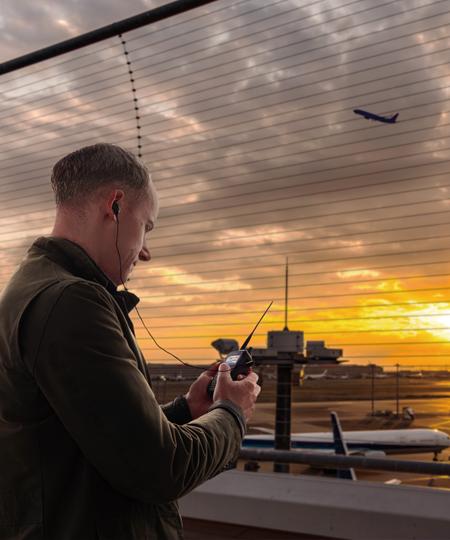
If you’ve ever wondered how to immerse yourself in the professional world of flight operations and the real-time coordination between a real flight deck and Air Traffic Control (ATC), a dedicated aviation radio scanner is the answer. Unlike many other countries, Airband monitoring in the UK requires a specific understanding of both the technology and the legislation.
How Aviation Communications Works
Civil aviation communication primarily takes place on the VHF (Very High Frequency) band, specifically between 118.000 MHz and 136.975 MHz.
Crucially, while most VHF radios (such as marine or business radio) use Frequency Modulation (FM), aviation relies on Amplitude Modulation (AM). The "capture effect" of FM would be dangerous in an aviation environment. AM allows two signals to be heard simultaneously ensuring that if two pilots "double" (talk at once) the controller still hears a heterodyne whistle rather than one signal completely blocking the other. Furthermore, AM provides a superior effective range for aircraft. AM signals travel much further than FM signals. While FM is limited to line-of-sight, AM signals can travel much, much further giving an aircraft on VHF a greater communication range. To listen in, you need a dedicated Airband receiver capable of AM demodulation and 8.33 kHz channel spacing—the mandatory standard across the UK and Europe.
The UK Legal Landscape: Is it Legal to Listen to Airband?
It is a common misconception that "if I can buy the radio, I can legally listen to anything it picks up." In the UK, the law is governed by the Wireless Telegraphy Act 2006.
Under current Ofcom regulations, it is technically an offence to listen to radio transmissions other than general broadcast, licenced Amateur or citizen band radio unless you are the intended recipient or have the permission of the sender. This includes aviation frequencies.
While equipment is freely available for purchase we urge all enthusiasts to be aware of the law. In practice, UK authorities generally take a pragmatic view of enthusiasts listening privately at air shows or airports provided the audio is not recorded, re-broadcast or used to facilitate illegal activity. We always recommend "discreet monitoring". The use of headphones is considered best practice and common courtesy in public spotting locations.
Choosing the Best Aviation Scanner: Handheld vs. Desktop
In the RF-heavy environment of a major airport like Manchester or Gatwick, cheaper scanners often suffer from "front-end overload" where pager towers or mobile signals bleed into the Airband. Icom’s receivers are engineered with superior filtering to ensure crystal-clear audio even in "noisy" environments.
The Enthusiasts Choice: IC-R6 and IC-R15
For the spotter on the move, the choice usually comes down to these two handhelds:
The IC-R6 (The Firm Favourite): The
IC-R6 has been the "go-to" compact scanner for aviation enthusiasts for many years. Its longevity is a testament to its reliability and performance. It is ultra-compact, offers up to 15 hours of battery life and provides the straightforward, high-quality analogue reception that has made it a benchmark in the hobby.
The IC-R15 (The New Kid on the Block): This is the modern successor for the digital age. The
IC-R15 introduces Dualwatch allowing you to monitor two different frequencies (e.g., Tower and Ground) simultaneously. It has a basic monitor scope that shows signals on the band when monitoring. It also covers the UHF Military bands which is handy at air shows or those who visit the military bases.
With a large colour display, Bluetooth for wireless headphones and microSD recording it is one of the most sophisticated handheld receiver currently available for the enthusiast.
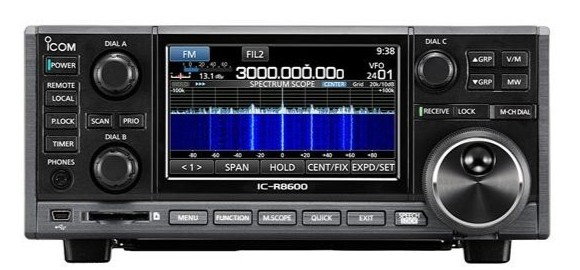
The Professional Base Station: IC-R8600
For the "shack" enthusiast who monitors from home the
IC-R8600 is in a league of its own. This isn't just a scanner; it is a wideband communication receiver with professional-grade SDR (Software Defined Radio) technology.
Visual Monitoring: The real-time spectrum scope and waterfall display allow you to see transmissions pop up across the band.
Extreme Frequency Range: Covering 10 kHz to 3 GHz, it handles civilian VHF and military UHF with unmatched sensitivity.
Interference Rejection: When connected to a rooftop antenna, the IC-R8600 can pull in weak signals from distant sectors that handhelds simply cannot reach.
Practical Tips for the UK Spotter
Find Your Frequencies: The UK NATS (National Air Traffic Services) publishes the Integrated Aeronautical Information Package (IAIP) online which lists every official frequency for every UK licenced airfield. There are many online frequency guides that can be downloaded for free. You can subscribe to one of the websites that update frequencies regularly or go old school and buy one of the dedicated Airband frequency guides that can be carried and checked while out in the field"
The Antenna Factor: The "rubber ducky" antenna included with handhelds is perfect for the airport fence. However, if you are monitoring from home with an IC-R8600, a dedicated external VHF Airband dipole or a "Discone" antenna mounted at height is essential.
Military Monitoring: Don't forget the UHF (225-400 MHz) band. While the IC-R6 covers this, the IC-R15’s Dualwatch allows you to keep one ear on civilian VHF and the other on military UHF at the same time.
Summary
Combining a high-quality Icom receiver with an ADS-B tracking app on your phone creates the ultimate situational awareness. Seeing the "blip" on your screen and hearing the pilot’s voice brings a professional depth to the hobby of aviation spotting.
Whether you are at the Heathrow Academy or a quiet GA strip in the Cotswolds, an Icom receiver ensures you don't just see the flight…you experience it.
Ready to Start Listening?
Whether you are looking to upgrade to the dualwatch capabilities of the IC-R15 or you are just starting out with the dependable IC-R6, Icom has the hardware to bring your hobby to life. For the ultimate home setup, the IC-R8600 offers a level of insight into the aviation bands that simply has no equal.
Explore the range and find your local dealer:
• View our full range of
Aviation Receivers & Scanners
• Contact
Icom UK Support: Have a specific question about 8.33 kHz spacing or antenna compatibility? Our UK-based team is here to help.