Satellite PTT: Robust Communication for Remote Operations
In today’s world, almost all organisations rely on cellular networks in their daily operations. From smartphones and 4G radios to fleet telematics and payment terminals, business depends on constant connectivity. Although they provide cost effective means of efficient communication, terrestrial cell towers can struggle in remote areas and even fail in disaster situations.
This article highlights the main industries that benefit from using
Satellite PTT (Push-To-Talk) radios and how they can be integrated with existing radio systems to create a dependable, unified network.
Why Satellite PTT Over a Satellite Phone?
Traditional satellite phones use geostationary (GEO) satellite networks and function like cellular phones, which require dialling a number before connecting to another device. Icom Satellite PTT radios provide instant group communication by leveraging the Iridium global Low-Earth Orbit (LEO) satellite network:
True Global Coverage: Because GEO satellites sit permanently over the equator, their signal degrades significantly as you move north or south, leaving blind spots. Iridium’s LEO network features overlapping cross-links that cover 100% of the planet, including both poles.
Ultra-Low Latency: GEO satellites are a considerable distance away and radio signal takes a noticeable time to travel to space and back, causing a lag during emergency broadcasts. Iridium satellites orbit at 485 miles above the Earth (about 46 times closer than GEO). This closer proximity drops latency to roughly 500 milliseconds, providing real-time communication that feels the same as a terrestrial radio network.
Overcoming Geographical Obstacles: If a fixed GEO satellite is blocked by a mountain, a high-rise building, or dense forest canopy, communication will cut off. Because LEO satellites are constantly moving across the sky, even if a signal is temporarily obstructed by a mountain or building, another satellite will pass overhead within minutes to establish a fresh line of sight.
Real-World Applications: Who Relies on Satellite PTT?
A wide variety of organisations currently use Satellite PTT radios for many different reasons but all have the same goal – to maintain operational control without the use of traditional ground networks.
• Energy & Utilities
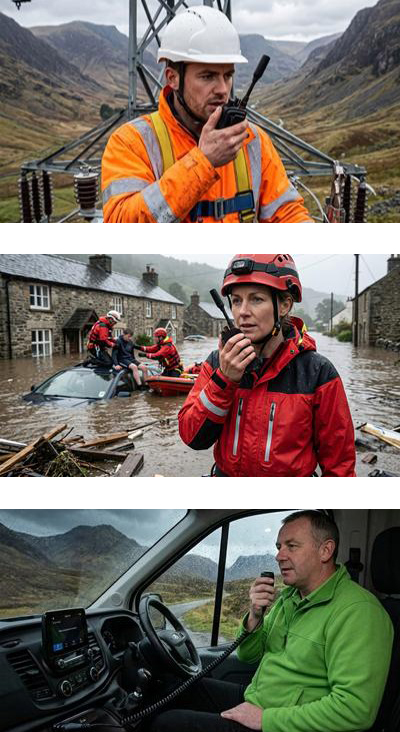
Utility providers manage expansive and often isolated infrastructure, from cross-country electrical grids to remote water reservoirs. These sites require routine maintenance, such as structural inspections, corrosion prevention and hardware repair. Workers often operate at extreme heights or near hazardous voltages, making clear communication essential, especially in remote locations.
The Operational Reality:
If a pylon in a remote valley needs an inspection, maintenance teams cannot rely on traditional two-way radios or mobile phones to coordinate with the central grid control room.
How Satellite PTT helps:
Because the signal is not blocked by the terrain, the team can stay connected and safe while they work. Some major construction or line-repair projects can span hundreds of miles across mountainous areas, in which case, Satellite PTT is the only viable communication solution.
• Emergency Services & Local Government
During regional disasters such as flooding or cyberattacks on local infrastructure, first responders can experience delays in passing on or receiving the information needed to deal with an emergency.
The Operational Reality: Traditional emergency radios rely heavily on fixed repeater networks. If a flood cuts the power to a repeater station or blocks access for fuel delivery to backup generators, conventional emergency radio coverage breaks down completely.
How Satellite PTT helps: Public safety sectors & local councils deploy satellite PTT radios at key strategic bases, emergency control centres and within mobile command vehicles. While local teams utilise standard terrestrial radios for close-range work, the satellite PTT link ensures that regional headquarters can broadcast critical orders and share real-time updates with every deployed unit simultaneously, removing the bottleneck of slower satellite phone calls.
• Any Businesses That Operate In Remote Locations
In the UK alone, companies covering places like the Scottish Highlands, the Outer Hebrides or Welsh Valleys would struggle to maintain efficient communication using terrestrial cell towers.
The Operational Reality: A supermarket chain offers a home delivery service covering rural Scotland, but their trucks must be equipped with a two-way radio for driver safety and lone worker safeguarding.
How Satellite PTT helps: Weather conditions can deteriorate rapidly in the area, leading to stranded vehicles or impassable roads - especially in winter. A satellite PTT radio would provide a reliable line of communication with the depot so that the driver can be redirected or assisted.
Expanding the Fleet: VE-PG4 Gateway Integration
For most organisations, additional satellite PTT radios need to be used alongside existing two-way radio technology to make them viable. A mixture of non-integrated equipment can cause a communication ‘silo’ where a team using digital or analogue PMR radios cannot speak to a team using LTE handsets, who in turn cannot speak to satellite users.
Icom solves this challenge with the
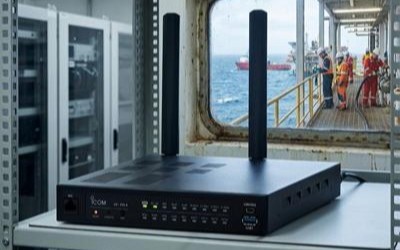
VE-PG4 RoIP (Radio over IP) Gateway. The VE-PG4 acts as an intelligent communication bridge, allowing the IC-SAT100 to integrate into almost any pre-existing radio infrastructure.
This enables seamless cross-platform communication across different two-way radio technologies:
VHF/UHF Digital & Analogue: Local security or utility teams using traditional
PMR
or
IDAS digital radios on-site can transmit audio that is automatically routed through the VE-PG4, up to the satellite network and out to an IC-SAT100 user anywhere on Earth.
LTE/ PoC:
Organisations utilising
Icom’s LTE radio solutions (like the
IP503H) can bridge their nationwide cellular talk groups with global satellite talk groups.
IP Radio and Telephone Systems: The VE-PG4 features a built-in SIP server which allows digital radio or satellite PTT users to patch directly into internal IP phone networks or call predefined telephone extension groups during an emergency response.
Integrating satellite PTT via the VE-PG4 builds a resilient, unified communication network that combines cost-effective local operations (traditional two-way radio) with seamless coverage for remote workers.
Icom Satellite PTT: True Operational Resilience
From remote operations and financial asset protection to disaster recovery, organisations need robust communication. The
IC-SAT100 and
IC-SAT100M deliver global coverage and when connected via the VE-PG4 gateway, they can keep your team coordinated through extreme weather, cyber-attacks and isolated workflows.
If you want to find out more about Icom satellite PTT solutions, call us on 01227 741741 or email us at
sales@icomuk.co.uk